Brown Voices Is Rereleasing This Fall — Here’s What’s New
I’m so glad to be able to write this post! My book on South Asian American experiences in schools — retitled as “Brown Voices: South Asian American Experiences in Schools” is being rereleased this fall, under my own imprint, after a very long journey to get the rights reverted.
If you’ve followed my work outside of fiction, you might remember this is the book based on my doctoral research at Johns Hopkins — research on how South Asian American students experience K-12 schools, how the model minority myth shapes the support (and lack of support) they receive from educators, and what teachers, administrators, and parents need to understand to better serve these students.
The book was originally published in 2019 by Rowman & Littlefield.
It found some scholarly readers: it was cited in journals, used in a few teacher prep programs, was listed in the Georgetown University Library’s Asian American and Pacific Islander Toolkit, and was used by professors and students. But it never reached the audience I’d actually written it for, because the original publisher priced it at around $100 for the hardcover and around $50 for the paperback, which meant that almost no working teacher, no curious parent, and no individual reader would be realistically buying it.
After five years of working to get my rights back, the book is finally coming back into print on my own terms (!!!) at a price that puts it in real readers’ hands.
(By the way, I’ve written about the full journey of getting the rights to this book back, so I can rerelease it, in detail here: The Brown Voices five-year Rights Reversion Saga.)
What has not changed
The empirical foundation of this book is exactly what it was when it was first published.
The studies underlying the core of the book are still the same, conducted under Johns Hopkins University’s Institutional Review Board, under the supervision of my academic advisors. The primary study includes a sample of 85 participants. Some of those core findings have even been published in the peer-reviewed Berkeley Review of Education. The participant narratives are intact.
This edition reflects substantial revisions to structure, organization, and presentation (which I’ll talk about in the next section) but NOT not to findings or conclusions.
The work has been made more readable and more accessible but it hasn’t been simplified in its substance (except for the removal of in-depth discussions of methodology, but if you’re so inclined you can read some of that here). Nothing has been altered to say something different than what the research found, even when it’s uncomfortable.
What’s different in the new edition of Brown Voices
Brown Voices will be affordable and accessible
The rerelease of Brown Voices will be accessibly priced—I won’t know the exact numbers until this Fall but the hardcover, paperback, and ebook will all be priced for regular libraries (not just university libraries) and with tiers of prices for anyone who wants it. You can also now read the major findings from my research here on my site.
Brown Voices will be widely available!
Amazon, Barnes & Noble, Bookshop.org, here on my site, from your local independent bookstore. Anywhere books are sold.
Brown Voices will be substantially revised and improved.
The book has been reorganized, streamlined, and rewritten for a broader audience.
The original edition was structured for a hybid audience (as this one as too) but with more content geared toward academic readers, since it was published by an academic press. This meant there was dense methodology up front, and that it was formatted for institutional use.
This edition is written FIRST for parents of South Asian American kids, for teachers, for education leaders, and for South Asian American adults who want to read their own school experience reflected back at them.
While the research findings are unchanged, how the work is organized and presented have changed. Now, methodology lives in footnotes and an appendix for readers who want it (and here on my site).
Brown Voices features new interview content
I’m most excited about this… The new edition weaves in conversations from the Be Inspired series, including portions of interviews, including (where relevant), words from poet Pavana Reddy (Mazadohta), and actress and filmmaker Sujata Day, ESPN anchor Kevin Negandhi, Broadway actor (and my childhood friend) Vishal Vaidya, and more.
The findings of the research explore so many of the challenges South Asian Americans face growing up—so I’m excited to include words from South Asian American adults who have created their own versions of success. Their stories add so much about not just what it actually feels like to grow up Brown in America, but also to what success (in spite of some of the challenges associated with growing up Desi here) can look like when defined on one’s own terms.
Brown Voices: South Asian American Experiences in Schools will have a new cover
The old title, South Asian American Experiences in Schools: Brown Voices from the Classroom is gone; the NEW book will have the primary title Brown Voices (subtitle: South Asian American Experiences in Schools).
Plus, a totally redesigned cover:
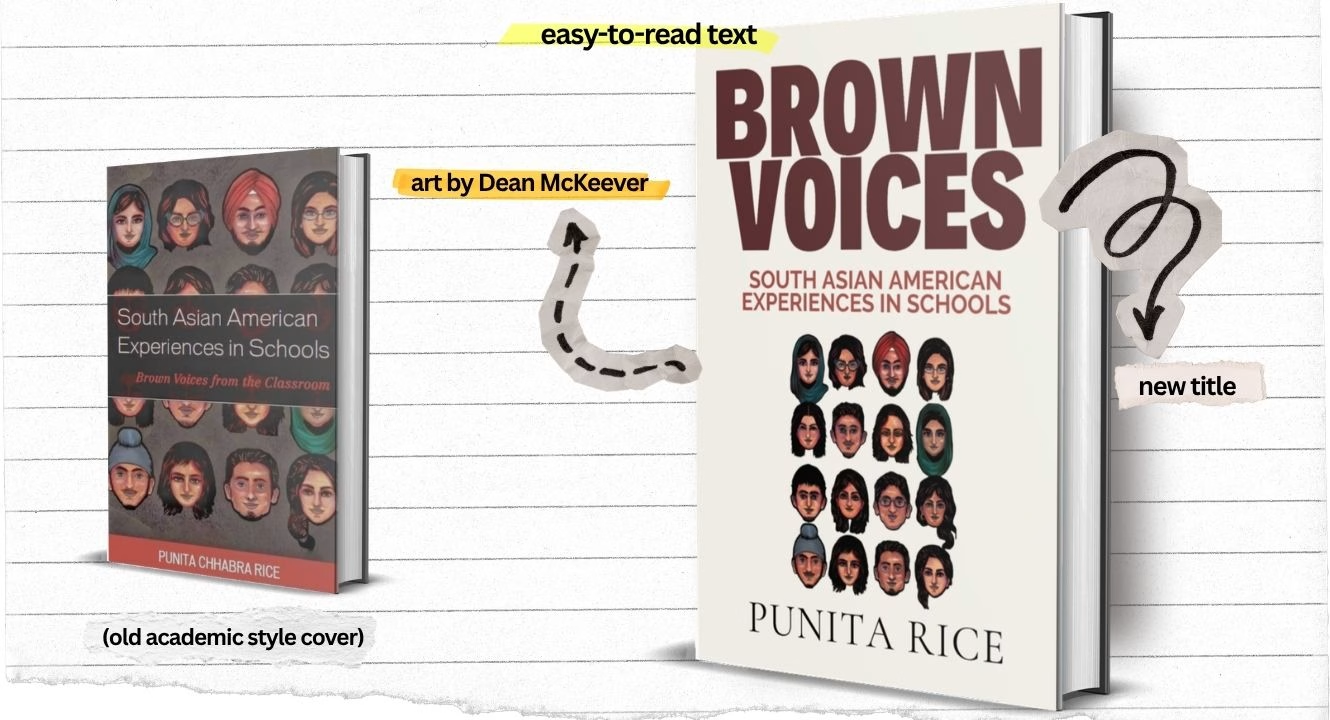
What’s changed (and stayed the same) in the cover?
- Clean, high contrast cover
- Larger, easier to read title
- The same gorgeous art by artist Dean McKeever is back, but this time is centered on the cover as a feature instead of fading into the background
- And of course, the new TITLE focusing on “Brown Voices,” with the subtitle offering clarification of whose experiences are being discussed
And of course, the new edition will be on my own terms.
The rerelease will be published under my own imprint, which means I will have full control over how this work is distributed and who it reaches.
Self-publishing was a VERY deliberate choice; academic credibility lives in the rigor of the research, not in who puts their logo on the spine.
If you’re an academic author thinking through this question for your own work, I’ve written about it here.
Why rerelease the book now?
When I first started the research that informed the original version of the book, I was a teacher (with plenty of Brown students). AND, I was a Brown adult, who was able to remember my own experiences as a South Asian American student in an American school pretty clearly. By the time I finished my research, I was a parent. By the time I got the book deal, I was expecting my second child.
When I started writing, I remember thinking: this is for the other Brown Millennials like me. If I can get this all out there, maybe our negative experiences won’t have been in vain. Maybe sharing these stories can make things better.
But South Asian American students are still systematically misread, or overlooked, or even treated unfairly in U.S. schools. The model minority myth, which is the stereotype that Asian American students are all high-achieving, well-supported, and don’t need help, creates real problems. South Asian American students who are struggling academically, socially, or emotionally get fewer interventions because educators assume they don’t need them. EVEN students who are thriving still report experiencing its side effects, and feeling less supported than peers from other backgrounds.
And beyond the model minority myth, South Asian American kids (when I was growing up, and the ones growing up today) are still experiencing forms of being othered, misunderstood, and having their needs overlooked in schools. These are patterns documented across participants in my research, and they show up in classrooms across the country every day, even now.
When the original book came out in 2019, my own kids were so young that I wasn’t yet thinking about how they’d one day be affected by what I was writing about. Now, in 2026, my kids are actually in schools and navigating those same experiences the research is about… I want this new version to be for the teachers who want to do this better. For the administrators thinking about cultural competence training. For the parents trying to understand what their kids are experiencing. For the South Asian American adults who recognize themselves in this work.
What’s coming next…
The book is TENTATIVELY slated for an October 2026 release. Event updates and a preorder link will be live soon—the newsletter will get the link first but once its out, I’ll update this post with the preorder link as well. The best way to make sure you don’t miss any of it, especially the preorder, is to sign up for my newsletter:
Thank you, to EVERYONE who’s been waiting for this book to be available (again!). I cannot wait for this work to reach you.
— Punita