Be Inspired: Jashvina Shah, Sports Journalist
If you’ve followed my earlier work with the Improving South Asian American Experiences (ISAASE) initiative, you may recognize Be Inspired. It’s a project rooted in the belief that representation matters, and that diverse stories of success matter.
This series was created to spotlight South Asian Americans whose lives and careers move beyond narrow expectations, offering younger generations a wider sense of what is possible.
For one of the conversations in this series, I spoke with Jashvina Shah, a journalist whose career reflects both persistence and adaptability. After producing more than 600 stories (ranging from breaking news and game coverage to features and multimedia work), Jashvina built a successful subscription-based platform for her reporting through the Princeton Hockey Blog, “Eye on the Tigers,” before moving into an assistant editorial role for a company that produces fashion magazines, where she supports reporting, writing, and broader production efforts.
In this conversation, Jashvina reflects on navigating sports journalism as a woman, the role her parents’ support played in shaping her path, and the advice she would offer young South Asian Americans considering careers in journalism. She speaks candidly about risk, persistence, and the importance of choosing to try, even without guarantees, and shares a piece of advice that was originally offered to aspiring journalists, but is applicable far more broadly:
“There is a chance it might not work, but you’re going to regret not trying to do it.”
In this interview, Jashvina speaks candidly about passion, risk, and persistence, and why choosing to try, even without guarantees, can be its own form of success.
Tell us about your journey into journalism.
I’ve always wanted to go into journalism. My Dad and Mom were always really great about encouraging me to do what I want. When I told them I wanted to go into journalism, my Dad said go ahead and do it. Journalism isn’t necessarily a business that can survive on its own, and my parents wanted me to have backup plans, but they did the best as they could to get me to where I am. In college, I majored in journalism.
What was it like working in sports journalism?
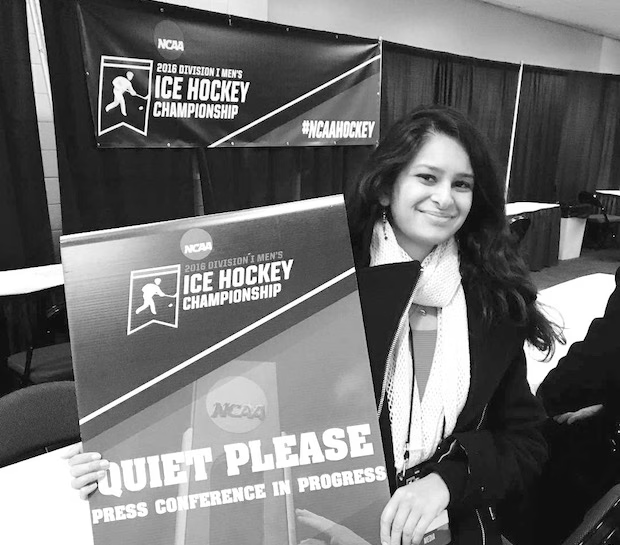
Sports can be hostile toward women — hockey, even more so. But I didn’t really notice it until after college. People either pay attention to you because of your looks, or not pay attention to you because of them; so sports journalism can be problematic, especially as a woman and person of color. But all things considered, I’d still rather be in journalism.
There are relationships you form and things that will always pull me back. I used to cover Princeton [hockey] and when I took this job, people — parents of kids who graduated — still wanted to follow my work. And getting tell people affiliated with BU hockey was really special. You form relationships.
What is it like working in fashion journalism?
I’ve always wanted to write for a magazine, and [getting to] is very rare nowadays. My current position is legitimate journalism. You do all the steps for interviews, you call, write, edit and ask follow-up questions.
It’s been really great to get to be a part of that full-time while getting to work in a magazine environment. I’m getting to pursue my passion.
What do you wish you had known growing up a South Asian American student in New Jersey?
I wish someone had told me how difficult it would be. The kind of racism I’d face. I grew up in New Jersey — I was far from being the only South Asian kid, since the majority of our community was Asian. And people said racist things to me and my brother — microaggressions and stuff like that. But it was a diverse environment.
There’s not much diversity in hockey, which is a predominantly white sport. For me, going from a diverse environment to a nondiverse one — when you’re not prepared, it just hits you, and it’s hard. I wish I’d been warned so that I could better prepare myself. Especially growing up in that sheltered environment, I never really saw being South Asian as a limiting factor.
What is Jashvina Shah’s advice for students who want to pursue journalism?
You just have to understand that it might not work out. I freelanced, I put a paywall on my site — it was tough. Especially in sports — and for women. It’s hard to get hired as a woman in sports journalism, especially since jobs are being cut. But I tell people, there is a chance it might not work, but you’re going to regret not trying to do it.
Deciding to do journalism is the best thing I’ve ever done. I’ve always been super introverted, and journalism has really pushed me out of my comfort zone. I have great stories from doing it, and I’ve made amazing friends and met some really supportive people in my life.
I’ve made a lot of good relationships. When things get difficult, that’s what you have to remember — what you get out of it. I wouldn’t trade these experiences for anything.
And what would you say to students whose parents may not want them to pursue journalism?
You have to remember anything your parents say comes with a measure of just wanting to see you succeed in life. They just might not know how to phrase it.
My parents felt if that’s what you want to do with your life, we’re happy that you’ll do something you love, and so I never thought this wasn’t an option for me. But if you decide something is your passion and your parents don’t [support it], and if you also value your relationship with your parents, you can still try to please them and still pursue your passion. You just figure out a way to do both things.
Photos courtesy of Jashvina Shah. Interview originally published as part of the ISAASE Be Inspired series. You can follow Jashvina on Instagram at @icehockeystick.
About Be Inspired
This interview is part of Be Inspired, a curated archive of conversations and profiles spotlighting South Asian Americans living bold, often un-stereotypically inspiring lives. Originally created through the Improving South Asian American Experiences (ISAASE) initiative, these stories are preserved here as part of an ongoing commitment to representation, storytelling, and expansive definitions of success.