
All the Fantasy Books Are Just Europe (and Why Fan Fiction Can’t Make Money)
When a fantasy author sits down to invent an entire world (where they can choose any world with any rules and magic they can dream up), they almost always just kind of invent a version of medieval Europe: Stuff like castles, knights, monarchs tend to show up, along with a “fantasy map” that looks suspiciously like a map of Europe.
In short:
- Fantasy keeps recreating medieval Europe because writers copied Tolkien’s setting, not his method.
- Tolkien built Middle-earth from Europe’s own half-lost myths, especially Finland’s Kalevala (it’s not his fault).
- The better way to honor him is to build from your own inherited mythology, which is how the world of Jaraan began.
- Shared worlds work as shorthand, which is exactly why fan fiction works, and why the rule that fics must erase their sources to be sold is backwards.
It’s not Tolkien’s fault
I think one of the usual arguments for why this is the case is to say it’s Tolkien’s fault.
But that’s not really true, because:
- J.R.R. Tolkien did not, in fact, invent European fantasy. Elves, dwarves, dragons, and Norse god types were already a part of European mythology and lore before Tolkien was even born, so he didn’t even create it to begin with, AND
- Tolkien’s approach was to BUILD his own world, inspired by lost mythology (and the Kalevala)… so the copycats that followed Tolkien weren’t even following his template of building a world based on a lost one, they were just copying his homework.
Tolkien believed England didn’t have a mythology of its own anymore; their Anglo-Saxon and Celtic material had been worn away by centuries of invasion, and he wanted England to have one of its own, and did so by trying to build a world inspired by his own country’s lost mythology. He even built the two Elvish languages based on existing European languages (the high Elvish language Quenya is based on Finnish, and the other major Elvish language Sindarin is based on Welsh), and his entire Legendarium was inspired by the Kalevala (a book and epic poem, and the national epic of Finland, based on Finnish and Karelian folklore in the 19th century), which had a massive influence on Tolkien.
In fact, here’s a side by side of Tolkien vs the original Kalevala (here’s the source)
- In Tolkien, “The sorcerer Sauron makes battle with the Elf king Finrod Felagund in a singing contest. Their music becomes magic spells and is so legendary that the event itself is immortalized in a song.”
- In Finnish myths, “The boastful Joukahainen challenges the wizard bard Vainamoinen to a song battle. Though Joukahainen is powerful, Vainamoinen is the superior musician and defeats Joukahainen with a song that roots him to the ground.”
Copying his homework (even the maps)
So if fantasy authors wanted to copy Tolkien, they should have followed his approach. The trouble is, fantasy books that followed did NOT follow his approach, and instead, copied his homework—literally. They copied his setting, vibe, aesthetic, world, etc over and over again.
Even the MAPS. Good lord the maps.
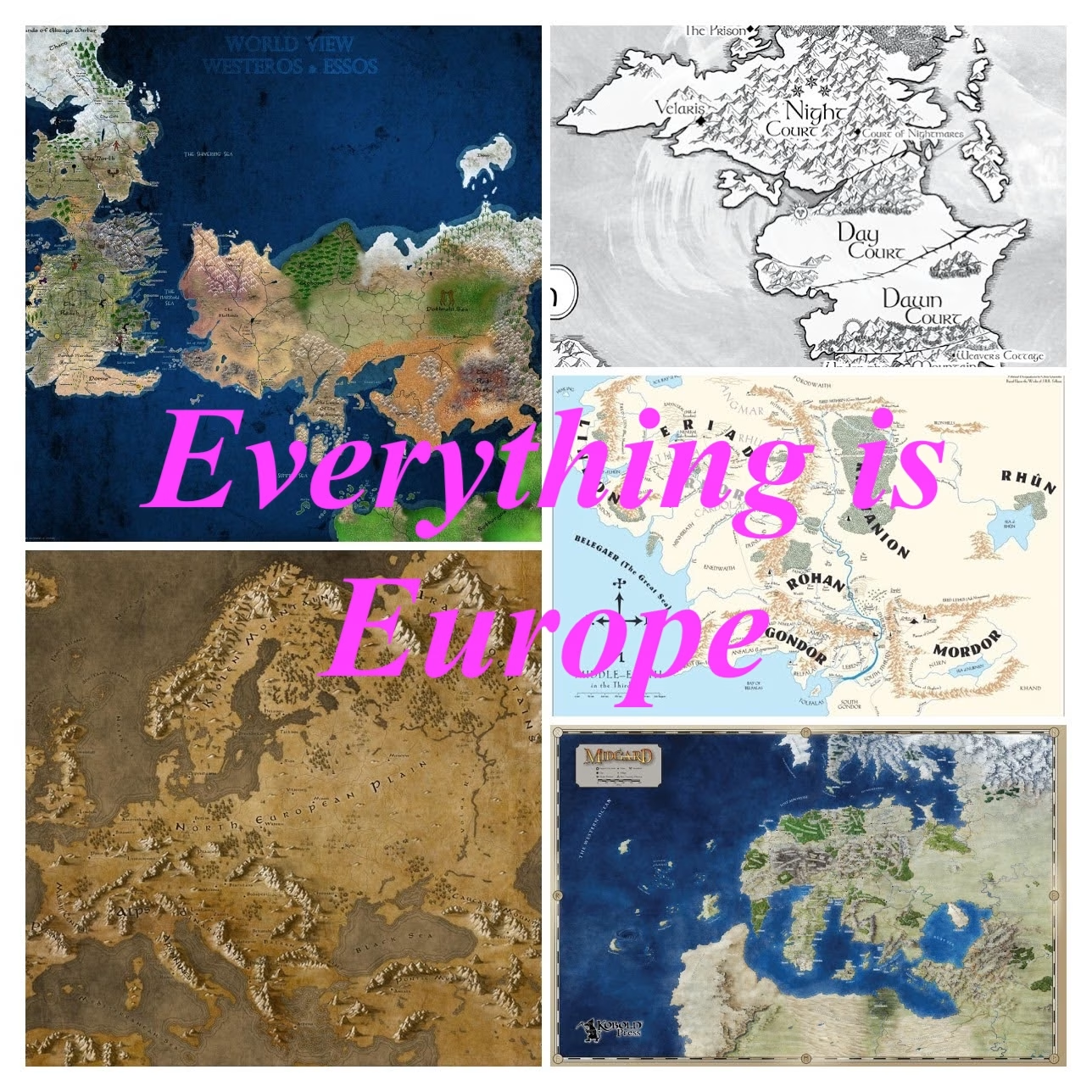
The castles, the English-ish countryside, the hierarchies, the whole aesthetic… it became what fantasy IS, and his world spawned thousands of fantasy books, games, and worlds that rely on the template he created as shorthand for fantasy itself:
- Narnia
- Dungeons and Dragons
- Elder Scrolls Online (ily)
- Harry Potter (arguably)
- ACOTAR series (arguably)
People are copying from his world rather than his methodology, which is: go home, build from your lost mythologies and stories, and create a world from that.
It’s like people just copied his answer instead of figuring out their own answer.
Building from your own mythology
Now I’m not putting myself in league with Tolkien but I will proudly tell you I that when I built the world of The River’s Daughter, I didn’t start from castles / Europe / Middle-earth. I went back to my roots and half-remembered mythology: I built my story inspired by the legend of Mirza Sahiba. My book’s world, the world of Jaraan, is a place inspired by the land of five rivers; and it’s not for the sake of diversifying my writing. Arguably it’s the same move Tolkien made, of pulling from your people’s mythology.
Tolkien had to reconstruct his world from old almost-lost stories (and the Kalevala), he had to research his way into figuring out that world. I’ve been lucky because the mythology I pulled from hasn’t even been buried, but passed down through oral tradition, and for that I’m so fortunate.
If you’re a reader of Tolkien and also a writer of fantasy, I’d suggest honoring him by building your own world based on your own inherited mythologies… and not just copying his setting.
Then we’ll have more stories that aren’t all… Europe.
Shared worlds as shorthand: why fan fiction can’t make money
Tolkien’s Europe works as shorthand for “fantasy,” and that same kind of shorthand is exactly why fan fiction works. A fic relies on an agreement between reader and writer that we’re in the same universe, using the same world-building shorthand. Which brings me to a question that’s been bugging me: why can’t fan fiction make money as fan fiction?
The first fan fiction I remember genuinely losing my mind over was AbsolutelyIris’s (2012) “Written in Reverse,” a Misfits fic about Alisha Bailey and Simon Bellamy. I sent it to everyone I knew who’d watched the show (exactly two people; exactly zero of them read it). It now has more than 15,900 hits.
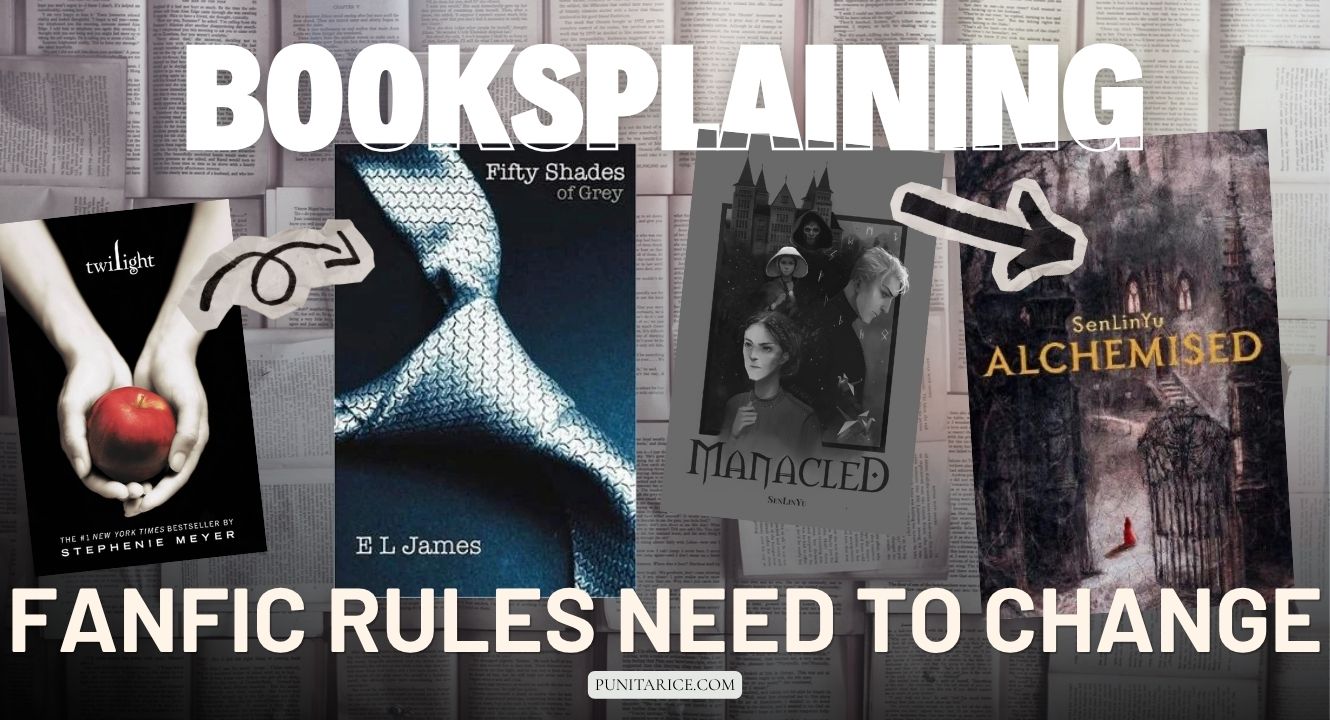
Fourteen years later, fan fiction that gets really big gets big book deals. Fifty Shades started as Twilight fan fiction, and back then it was an open secret. Now publishers openly lean into it, especially with a wave of Harry Potter fics:
- SenLinYu’s Alchemised, which started out as Manacled
- Julie Soto’s Rose in Chains, which started out as The Auction (part of a series, written under the name Lovesbitca8)
- Brigitte Knightley’s The Irresistible Urge to Fall for Your Enemy started out as Draco Malfoy and the Mortifying Ordeal of Being in Love (written under the name isthisselfcare)
- Ali Hazelwood’s The Love Hypothesis (which started out as a Star Wars / Reylo fic)
Strip the source, sell the book
To sell them, the authors have to remove every trace of the source material and swap in something “original.” I get why: stripping the identifying details is what puts the new work outside the scope of the copyrighted one. I just think it’s spiritually and ethically backwards.
In nonfiction, which is almost always derivative to a degree, we cite our sources. (Legally that’s not the same thing: facts and ideas aren’t copyrightable, while the characters, worlds, and plots a fic borrows are. But citing should count for something, morally.) In fan fiction, you have to erase where your story came from in order to profit, and the resulting book is often worse for it. The shared context was the whole reason to read it, and most of us know what it’s based on anyway.
Why can’t fan fiction make money as fan fiction?
Most authors already welcome fan fiction when no money is involved, so the real issue is commercialization. The strongest argument against letting fics profit as they are is that they could act as a “market substitute” for the original. But the people reading fan fiction are almost always fans of the original. I wasn’t reading Alisha/Simon fic at random; I read it because I adored them in Misfits. And you don’t accidentally become a Dramione shipper reading Manacled if you’ve never touched Harry Potter.
Copyright also protects an author’s control over the derivative market (sequels, spin-offs, adaptations), and a wildly successful fic, even a properly cited one, could compete with that. I don’t have an easy answer. But a well-written policy could handle it, and today’s system, where popular fics strip out their source and profit anyway, arguably abuses the spirit of the law already.
Rules for letting fan fiction profit
A few suggestions, from a fan fiction lover (not a copyright lawyer):
- CITE your source: Fanfiction authors must cite the original source; the front or back matter of the book should clearly state what original work the fic is drawing from and who created that original work (the same as how a citation is treated in nonfiction).
- DON’T remove source material reference points: If a particular character/concept is pulled from a source work, make that clear in the book’s front/back matter. I’m not sure what this would look like in a legally enforceable capacity but essentially something that indicates who/what the characters are would be a solid start.
- Make a good-faith effort to reach the original creator: This one might not be a legally enforceable suggestion either, but maybe as a best practice, authors aiming to profit from a derivative work should, rather than hiding the source, actually extend the courtesy of letting the original creator (assuming they’re alive) know about the derived work.*
*And if that creator says no, maybe you respect that.
A properly cited fic would work a little like parody or critique: in conversation with its source, and maybe even sending that source a bigger audience. Parody is protected because it critiques the work it borrows from; I think continuation deserves protection on different grounds. As a former history teacher, I can tell you that “this is the law” and “this law makes sense” are two very different things, and a framework that prefers erasing your sources to citing them is… ass-backward.
Questions
Why are so many fantasy books set in medieval Europe?
Because later writers copied Tolkien’s setting (castles, knights, an English-ish countryside, maps that look like Europe) instead of his method of building a world from his own culture’s lost mythology. That template became shorthand for “fantasy” itself.
Did Tolkien invent European fantasy?
No. Elves, dwarves, dragons, and Norse-style gods were already part of European mythology. Tolkien built Middle-earth from it, drawing heavily on Finland’s Kalevala and basing his Elvish languages on Finnish and Welsh.
Why can’t fan fiction make money?
Under current copyright law, the characters, worlds, and plots a fic borrows are protected, so fan fiction can only be sold once its source material is stripped out. That’s why published fics like Alchemised (originally Manacled) remove every trace of Harry Potter.
How could fan fiction be allowed to profit fairly?
Punita Rice suggests three rules: cite the original work and its creator, keep the source’s reference points visible instead of erasing them, and make a good-faith effort to let the original creator know.
Extra credit reading:
- Books Inspired by Tolkien
- How Tolkien Disguised Ice-Age Europe as Middle Earth: The Lost History of Middle Earth, Part 1 (blog post – Andrew Henry, 2022)
- Kalevala (From Tolkien Gateway)
- Middle Earth Isn’t Medieval (blog post – Thomas Brodey, 2021)
- The Constructed Languages of Tolkien – PBS
- Tolkien’s Legendarium (Wikipedia)
- Tolkien and the Kalevala
- Works inspired by JRR Tolkien (One Wiki to Rule Them All)
- 7 fantasy books like Lord of the Rings to take you on epic adventures (Owlcrate)
- Also interesting – Eastern European Fantasy Post-Tolkien (blog post)
- Elizabeth Minkel’s (2024) “Lots of People Make Money on Fanfic. Just Not the Authors” (Wired.com)
- Fox Blue Sunflower’s (2025) “The Fanfiction Money Problem (Or: Why Your 500,000-Word Epic Paid You Nothing)“
- Royal Road (2020) discussion on making money with Fanfiction (forum)
More of my reading recommendations are on my Amazon page ↗.

